
Keep pace with the rapidly evolving fintech industry by subscribing to the BIGcast Network. Get weekly insights from industry leaders John Best and Glen Sarvady, delivered straight to your preferred podcast platform. Join our community and stay informed about the latest trends shaping the credit union industry. Subscribe today and ensure you’re always ahead of the curve.
Looking for the X-Factor in Stripe’s PayPal Bid

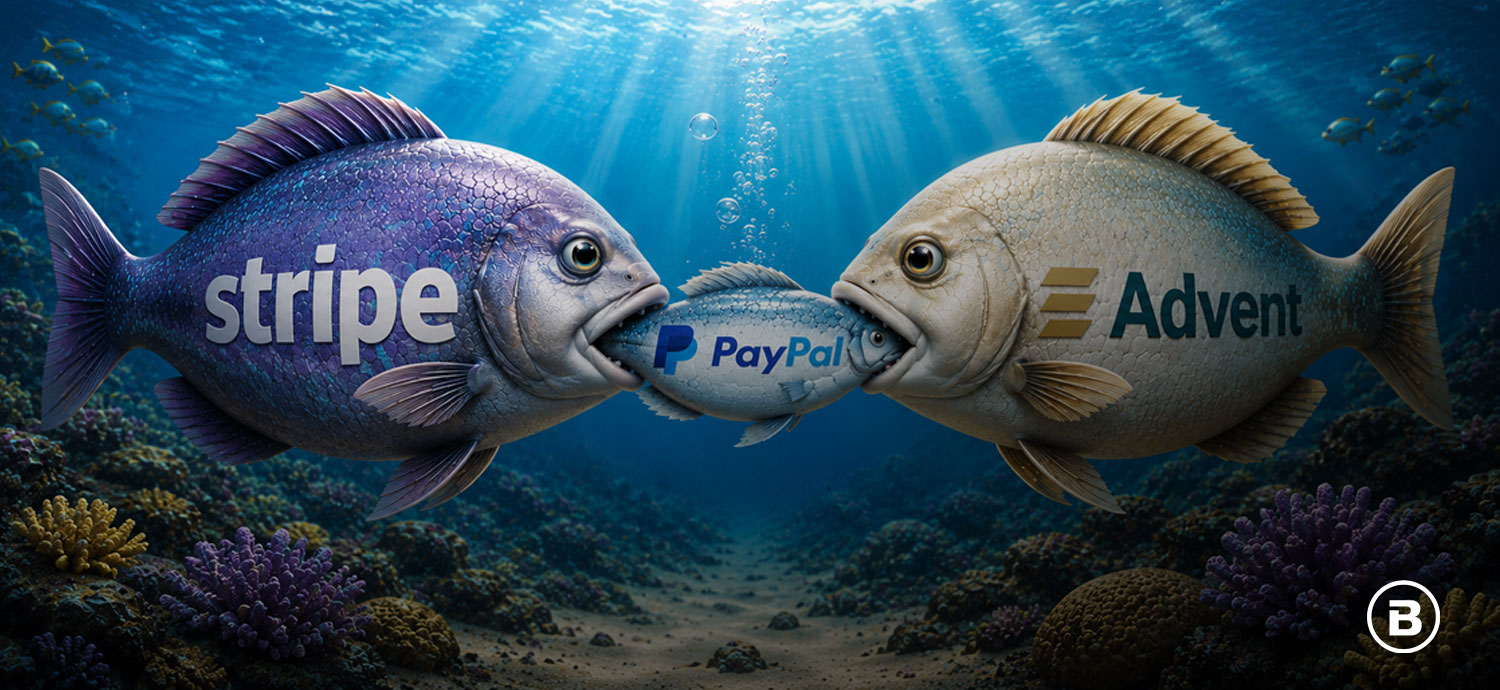
By now you’ve probably heard about Stripe’s recent $53 billion offer- alongside private equity firm Advent International as an essentially equal partner- to acquire PayPal. You’ve probably also heard that PayPal’s board has rejected the offer as insufficient. Odds are good this saga is far from over, however. Let’s explore a few of the angles that are poised to keep things interesting.
Stripe’s offer of $60.50 per share was roughly 28% above PayPal’s then market price. At first glance that sounds like a healthy premium, but good luck reaching a consensus on PayPal’s long-term value. Even after the resulting bump it remains down 25% in 2026, and for those fond of dabbling in extremes, it’s less than one-fifth the stock’s all-time high set in 2021.
PayPal was the epitome of a pandemic darling, shooting to nearly $300 when it appeared consumers would never again return to brick-and mortar checkout. Even ignoring that 2-year bubble, PayPal’s stock remains well below the $80-100 range it established both before and after the shutdown.
It’s worth noting that investors reacted to Stripe’s proposed 28% premium by bidding the stock up by only about half of that amount (16%). When PayPal’s board rejected the offer, interestingly, the stock held its gains. This seems to indicate traders anticipate further overtures, but expect nothing to resolve in the near future.
It’s also tempting to speculate how Stripe’s and Advent’s motivations may align and diverge. Privately held Stripe was most recently valued at $159 billion- precisely three times its PayPal offer. Many analysts surmise that the PayPal asset Stripe most covets is a consumer wallet with widespread brand recognition. Ironically, that wallet is Venmo- a platform PayPal acquired as a ride-along to a much larger 2013 acquisition (Braintree), and for which management endured questions for a decade on how it would be monetized.
As for its more vanilla payment processing business, PayPal recently realigned its operating divisions to make it a standalone reporting unit. Advent has plenty of experience overseeing such shops in its extensive financial services portfolio. Although one could easily envision the businesses being split apart, both Stripe and Advent insist the plan is to operate PayPal as an intact entity- consistent with Advent’s typical approach.
Here’s where the intrigue kicks in- I first learned through Nic Milanovic at This Week in Fintech (and corroborated via Reuters) that during the early stages, Block also played a role in formulating the bid. Although no longer involved by the time the offer was made public, Block’s ownership of CashApp suggests yet another twist- perhaps Stripe and Block were both jockeying for a piece of Venmo?
And let’s not forget that Block is led by Jack Dorsey, who not long ago was involved in a contentious transaction with Elon Musk… whose initial claim to fame came as part of the “PayPal Mafia.” Musk merged his online banking company X.com with PayPal in 2000 and depending on which version of the story you believe, may or may not have been forced out amid friction with the rest of leadership.
Given Musk’s aspirations for his current iteration of X Money, the intertwined histories and egos involved, and the fact that he saw fit to pay $44 billion for a much less substantial business like Twitter, I’ll be surprised if Elon doesn’t enter the chat at some point.
For that matter, there are so many moving parts to this story that it’s a near certainty some components will circle back into the headlines in the coming months- if not sooner.